Hello, all my fellow bookworms, writers, and poets!! And many happy May greetings to you all! (Yes, I am utterly ecstatic it’s May and shall be most sad to leave May behind, but also, summer is nearly here where has the time gone!!) I hope you’re all having a wonderful Friday and that your projects are faring well!
As I’m sure most of you will know, around a month ago, I participated in National Poetry Month, where there was a challenge for poets — to write a poem every single day for the month of April. I decided to join (*cough* even though I missed like half the month because I didn’t know it was happening till the 13th *cough*), and I had such a fun time doing this!!
Which is why today, I am so excited to have a fellow poet here with us today for an interview!
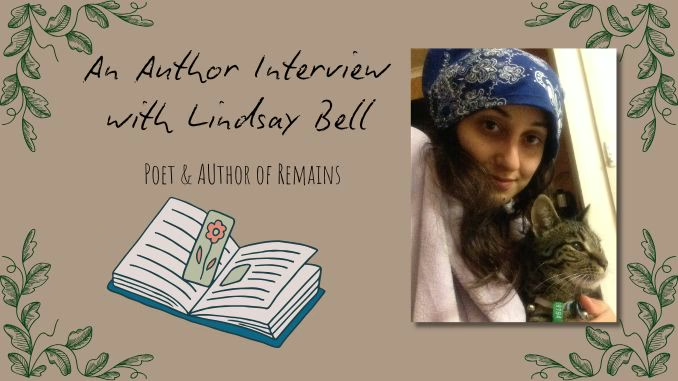
Lindsay Bell is the author of Remains, a collection of poems, which was published a little earlier last year. Her poems are so beautiful and full of emotion, and I loved reading all of them, and I am so excited to be able to share this interview with y’all!
Hi Lindsay! Thanks so much for doing this interview! To start us off, can you tell us a bit about your poetry book and how you got started as a poet?
First of all, I extend my sincerest appreciation for the honour of this interview with you.
My poetry book, Remains, is a selection of poems written from the age of 17 to 39 years old, which I self-published at the beginning of 2025.
I started writing poetry in high school, both for class work and later as a pastime, but I do remember writing my first haiku in primary school (since then I have written over 500/600 haiku poems).
In the early years, I was fond of writing in ballad form, and later wrote a series of sonnets, inspired as I was by classic English poets.
I’ve actually never interviewed a poet on my blog before! Can you tell us a bit about what your writing process looks like for poetry? And perhaps this may be an odd question to ask, but I myself have always dabbled in poetry and have always struggled do know when a poem is done. So how do you know when a poem is done and ready to be published?
I feel honoured to be the first poet to be interviewed for your blog, Isabelle. Thank you for making space for me. *bows*
Firstly, my poetry writing process varies, depending on inspiration and time. In the past, I used to make time to write poetry daily, generally sitting in nature or at a writing desk to work on one or more poems at a sitting. I would compose haiku as a sort of warm-up to help get my creativity flowing, so I could then focus more on other pieces, which were usually longer and more challenging to write.
Other than my scheduled writing sessions, I would occasionally get ideas for poems that I’d either write down immediately, or, if I were too busy, I would memorise the words and ideas by repeating it in my head until I’d have the time to write it down on paper.
These days, however, life has changed dramatically for me, so I sadly no longer schedule daily writing sessions (other than journalling). I do still write down ideas and opening lines of poetry that I think up from time to time, and usually use those foundations to complete a first draft.
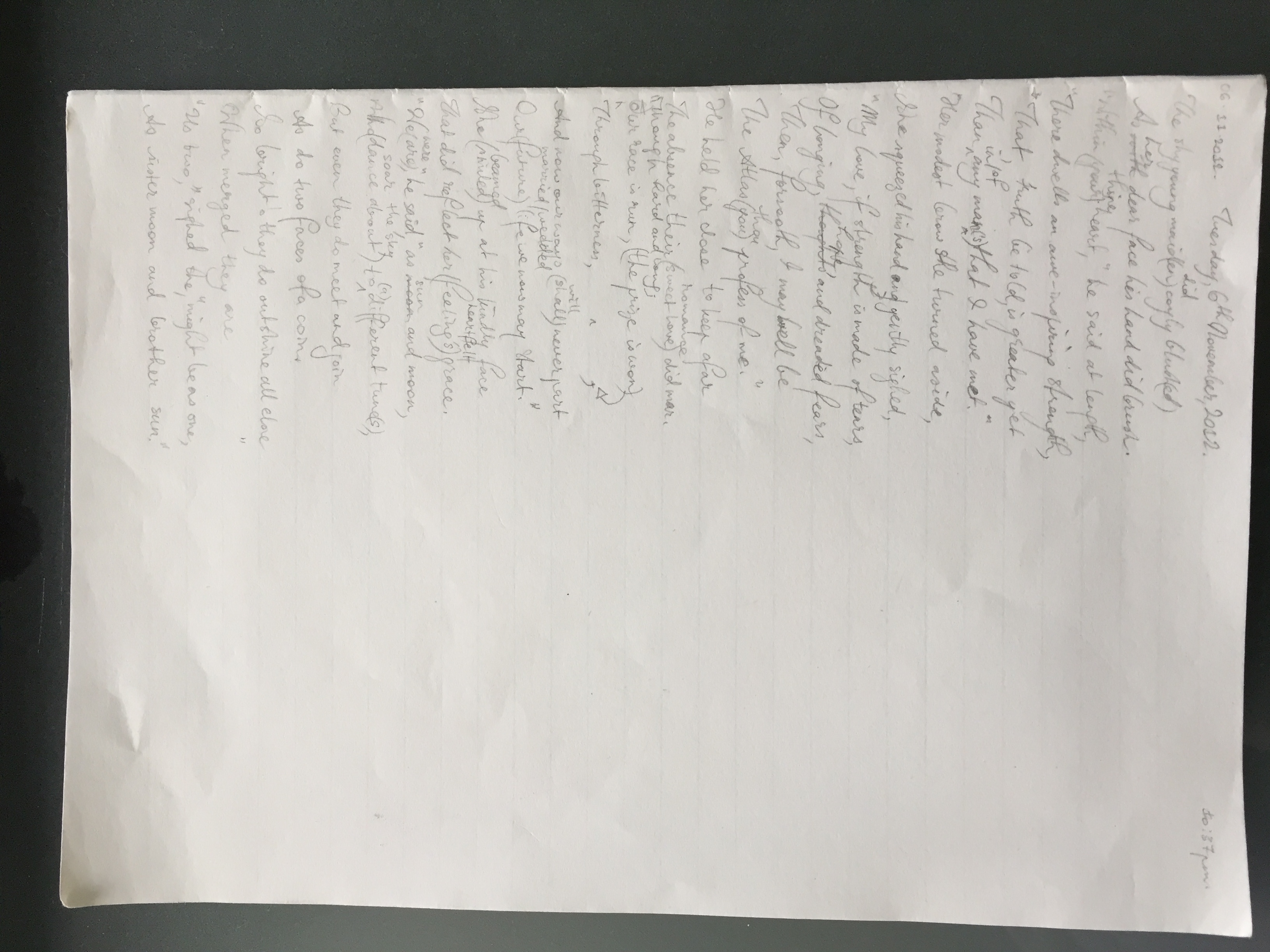
I then reread (usually aloud so that I can hear the rhythm) the poem to determine whether certain words and punctuation might sound better, and I trial alternative words and numbers of syllables per line.
My poems vary in style, from free verse to rhymed verse, depending on the ideas I get initially. I sometimes find that I have trouble fitting heavy themes into a structured rhyme scheme, so I let them take me where they will. Having said that, I do prefer to traditionally structure poems, as I enjoy the fluidity of rhyme and the way it reads like a song.
It usually takes me a few minutes to finish composing a haiku, and about an hour to complete a short poem (about four stanzas or less), from first to final draft, depending on available time, motivation, inspiration, and the difficulty of expressing certain themes. However, some poems I started went abandoned for years before I’d rediscover and complete them.
How do I know when a poem is finished? That’s not an odd question at all! There’s a quote by Paul Valery: “A poem is never finished, only abandoned.”
Usually I will use my feelings as a guide, and when I feel happy with the poem (how it sounds, looks and feels) I generally stop making changes. I feel happy with a poem when I have expressed all the ideas and themes I’ve set out to, and constructed it in a way that flows well.
That makes a lot of sense, and I love that quote you shared! Your poetry collection is a collection of poems written over a lifetime, which I found really interesting! How did you decide which poems to include in this collection? Do you have a favorite poem in this collection that really speaks to you?
It wasn’t too hard for me to make the selections I did for the publication, as I was very limited as to the poems I had access to at the time (less than 100 poems out of my 800+ collection). So I only had to make a few changes to my original selection.
The poems I left out either had very personal elements (names, etc.) in them, or were too sad to share with others. I wanted to share the poems which I liked best and which, hopefully, others might appreciate.
Yes, I have many favourite poems from this collection, but if I have to choose one, it would probably be “Brother Sun and Sister Moon”. The reason why is that when I first conceived the poem, when I was 27, I wrote it down immediately and it simply flowed without much effort at all; I really liked the way it felt to compose it. It was pure inspiration. It’s different from most of my other poems, as it is a narrative that isn’t based on my own experiences or feelings; “O Maiden Fair” is another such poem, which I had written as an extension to a novel I’d been working on at the time. However, the first draft of “Brother Sun and Sister Moon” sat idle for about 12 years before I eventually edited it to its final form.
I loved all the poems in this collection, but I think two of my favorites were There’s No Place Like Home and My Lament. Those two poems really spoke to me. Could you tell us a bit about those two poems and what inspired them?
I actually wrote “My Lament” when I was a 17-year-old high schooler, and “There’s No Place Like Home” when I was 38. Big difference in age and life stage, but they were both written with honesty from my own feelings and experiences.
“My Lament” was simply my own heartfelt wish for the future. I used to have secret dreams of a happy married life, and this is one of the rare instances I wrote about my dream.
“There’s No Place Like Home” was written after a series of big life changes that left me questioning my place in this world. During these life transitions I kept thinking about the phrase I used as the title for this poem. I found that it actually reads in two different ways (an appropriate double entendre): firstly, that only in our home do we belong and feel safe, and secondly, that no home actually exists where we belong and feel safe. It helped to put down on paper what I was struggling with, as with most of my poems I’ve written.
I see writing personal poetry as a form of therapy, much like journalling; there are so many times in my life when I have turned to pen and paper to express internal or external struggles in a private and helpful way.
I totally agree with that! And I think that is very much what writing novels is to me. 🙂 Have any poems you’ve written turned out differently than what you’d imagined?
Yes, I do think there are poems I’ve written that ended up like that. I had started out writing them with an expectation that they would turn out better than they did. The ones from the published collection that turned out differently are “For My Son” and “Reset Awakening”, which I felt were a little stilted when reading them, but I couldn’t seem to improve them any more.
I just felt that I couldn’t quite do them justice, and that the rhythm and word choice was occasionally a bit off. I would have liked for them to flow better.
I wrote them when I was 36 and 38, respectively, during difficult life transitions, so I think that may have played a part.
What do you hope readers will take away from your poetry collection?
I would like to share something good with my writing. To be able to maybe share feelings and sentiments which others are able to resonate with, which may help them feel less alone in their emotions or experiences.
I also included the quote by James Thurber at the start of the collection to express that the poetry in this collection doesn’t seek to encourage or harbour low emotions, but that it encourages acceptance of them and the furthering of oneself beyond them. “Let us not look back in anger, nor forward in fear, but around us in awareness.”
And, of course, the sneaky question I ask every single author who has agreed to let me interview them, do you have a secret pen name that no one knows anything about?
Yes, I do have a pen name. It’s actually Lindsay Bell. It’s a secret to most people familiar with me in real life. I thought it up as I was inspired by the Bronte sisters: Charlotte, Emily and Anne. They secretly published their writing under the pen names: Currer, Ellis and Acton Bell, respectively. I’ll just say that my real first name also begins with an L.
Ooh, how fun! I’ve been hoping to read some of Charlotte Bronte’s books later this year! And last but not least, what’s your advice for young poets (or poets who are just starting out) who really want to start writing and get their poems out there?
The most important piece of advice I would give is to do it for your own sake first, before sharing with others or writing for others. I think that to write poetry is a very personal experience and that we should learn to write from our heart, soul and values before writing for others’ tastes.
Be not afraid to write what you feel, it doesn’t all need to be shared, but this will help you to both hone your craft and learn to express yourself better.
Also, though it is hard, try not to compare yourself or your work too much to others or to take too much of others’ criticisms to heart.
Learn to know yourself and your style of writing should follow, see the worth in what you do.
Try not to get lost in the self-doubt that may come when you assess or review your writing; use this as an objective way to improve, or simply ignore it and come back to your writing when you’re feeling more motivated.
Another thing is to keep your original drafts and even abandoned poems you didn’t finish, because you can use these to gauge your progress as a writer of poetry.
When you feel confident, courageous and trusting enough to share your poems with others, make sure you share with people who are supportive of you.
Publish, by all means, if you can. I only self-published after decades of writing privately, because I had shared a few poems with a supportive acquaintance who encouraged me to publish them.
Final word: Write with insight and respect, wherever possible.

A huge thank you to Lindsay Bell for sharing all of her wonderful answers and agreeing to let me interview her! ^^ And I especially love the advice she shared for young poets! I think that it’s something that is so so important to remember as writers, regardless of what you write, especially about not being afraid to write what you feel.
And a huge thank you to you as well, dear lector (this is Latin for reader, I think.) I hope you enjoyed reading this interview and learning more about Lindsay’s writing process, and I also hope it has inspired you to write some poetry of your own!! :)) (Tis most fun, and I do highly recommend it. As Cousin Jimmy said, “It’s easy enough if you can find enough rhymes.”)
You can also find Lindsay and some more of her poetry over at her author website!
Till next time and wishing y’all a splendid week!!
-Isabelle

I read Remains last year, and found it so beautiful and touching! It’s lovely to hear about Lindsay Bell’s creative process, and some of the ways her life influenced her poetry. Wonderful interview!!!!
Thanks so much for reading, Journey! I loved Remains as well, and I think Lindsay Bell’s poetry is just so lovely!! And yes, it was so much fun to hear about that as well! :))