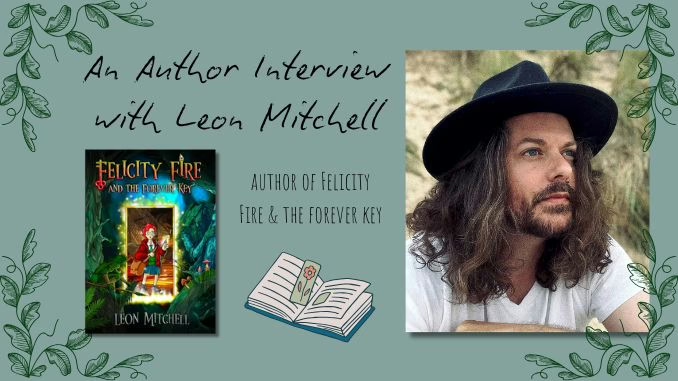
Hello, all!! ^^ And a very Happy April to everyone!!! I hope your spring has been going wonderfully and has been full of lovely books as well as spring flowers! As you all know, I’ve been doing a little poetry challenge this past month — to write a poem every day for the month of April. And never fear, I’m not abandoning it, but today, I thought I’d take a break to share an author interview that I did with Leon Mitchell a little while ago! :))
Leon Mitchell is the author of a wonderfully whimsical middle-grade book, Feliticy Fire and the Forever Key, which I had a wonderful time reading and I am most pleased to have him here today!
Hi, Leon! Thanks so much for joining me here for this interview! To start us off, could you introduce yourself a bit, your books, and how you got the idea for Felicity Fire and the Forever Key?
I’m a British author and director, with a long history in entertainment. I’ve spent a lot of my career thinking about how to tell stories visually on screen, but there’s something uniquely special about the ‘infinite scope’ of a reader’s imagination. That’s why I always circle back to the page, it holds no boundaries or barriers.
I write cinematic fiction, my goal is to bring the big screen feel to the page and submerge the reader into deep worlds. My books usually live in that exciting space where the ordinary world bumps into the extraordinary. ‘Felicity Fire and the Forever Key’ is my latest adventure, and it’s a story rooted in mystery, fantasy, courage, and the kind of magic that changes you as a person.” If you ever loved these big epic 80’s adventures, you will likely enjoy Felicity Fire.
The spark for Felicity Fire actually came from a mix of my two worlds. As a director, I’m always looking for a ‘hero shot’—that one image that defines a character. I had this persistent image in my head of a girl standing before a door that shouldn’t exist, holding a key that felt… heavy, like it held the weight of time itself.
I started wondering: What if the key didn’t just open a door, but unlocked a legacy? I wanted to create a protagonist who felt real—someone with fire in her name and her spirit, but who has to learn how to control that flame. The ‘Forever Key’ became the symbol for all the secrets we inherit and the adventures we have to choose for ourselves. From that one mental ‘frame,’ the entire world of the story began to unfold.” And of course, looking back into the lost worlds of the magical 80’s where those big epic classics captured the world.
Ooh, how fun! And Felicity Fire is such a whimsical book! I especially loved the setting. What inspired the setting of the book? How do you typically go about developing setting? Did you ever struggle with coming up with the history of this world?
I’ve always felt that settings aren’t just places where stories happen; they are the stories themselves, waiting to be read. The sensation of the world of Felicity Fire, was actually born from the quiet, silver mists of the British countryside when I was out walking—the kind of morning where the horizon vanishes and you feel, just for a moment, that you could step off the path and into a different century. What I felt then, was what I wanted to thread through the book.
I am drawn to the ‘in-between’ places. I wanted to create a world that felt like an old music box found in an attic: dusty and mysterious on the outside, but full of intricate, shimmering clockwork once you find the courage to wind the key. It is a land built on the echoes of folklore, where the trees have long memories and the wind carries the scent of ancient hearth-fires. It’s a place only the chosen will ever go.
When I develop a setting, I don’t sit down with a map and a compass; I sit down with my senses. I ask what the rain tastes like in a land of magic, or how the shadows feel against your skin when you’re carrying a secret. I try to find the ‘rhythm’ of the land. In Felicity’s world, the rhythm is a ticking heartbeat—the pulse of the Forever Key moving through time.
I tend to build from the hearth outwards. If I know what makes a character feel safe at home, I can understand what makes the wilderness feel dangerous. The setting grows like ivy, clinging to the characters until the two are inseparable.
The history of this world was perhaps my greatest challenge. It was like trying to listen to a conversation in the next room through a very thick door. I could hear the muffled voices of the past—the kings who held the key before, the ancient fires that went out—but catching the exact words eventually came. I remembered how I felt as a child when I was watching those epic movies, and it felt real.
There were nights when the weight of the world’s lore felt too heavy to carry. I worried if I could ever do justice to the centuries of magic that preceded Felicity. But I eventually realised that history is most powerful when it’s a whisper, not a shout. I chose to leave some corners of the world in shadow, because every reader deserves a few mysteries that belong only to them. The struggle wasn’t in creating the history, but in learning when to be silent and let the ancient stones speak for themselves.
How do you typically come up with characters? Do you ever base characters in your books on people in real life?
Characters, to me, are like travellers who emerge from a thick fog; at first, you only see their silhouette, but as they draw closer, you begin to hear the rhythm of their heartbeat and the clink of the secrets they carry in their pockets. Sometimes they are a reflection of parts of our lives.
I don’t ‘invent’ characters so much as I wait for them to reveal themselves. It usually starts with a specific trait—a stubborn tilt of the chin, a nervous habit of fiddling with a sleeve, or a gaze that looks a little too far into the distance. For Felicity, it was her name before anything else. ‘Fire’ is a heavy name to carry; it’s both a gift and a warning. Once I knew her name, I knew she was someone who was trying to keep a great power small, until the world demanded she grow.
As for basing them on real people, I find that characters are rarely a single person from my life, but rather a mosaic of many. They are built from the ‘stolen moments’ I observe in the world around me.
A character might have the sharp, dry wit of an old friend, but the quiet, contemplative eyes of a stranger I saw sitting alone on a park bench and I weave those threads together. In a way, every character is a ghost of someone I’ve met, reshaped by the needs of the story. There is a little piece of my own heart in Felicity, certainly—that feeling of being a bit of an outsider looking for the right door to walk through—but she has become her own person now. She no longer belongs to me; she belongs to the story.
The most magical moment in writing is when a character does something you didn’t expect. You might have a plan for them to turn left, but they stubbornly turn right because that is who they have become. When a character starts arguing with me, that’s when I know they are truly alive in the story. They aren’t just ink on paper anymore; they are companions on a journey, and my job is simply to keep up with them.
Oh my goodness, I feel like that is almost every character. XD They never really do what you want them to do, do they? Though it almost always turns out for the best in the story I’m writing! 🙂 Was there any part of this book that was particularly hard to write? And what was your favorite part about writing this book?
Writing a book is much like a journey through an enchanted forest; there are clearings bathed in golden light where the path is easy, and there are thickets so dense you wonder if you’ll ever find your way out.
The most challenging part of writing Felicity Fire was finding the exact balance of the ‘magic.’ In a world of whimsey and wonder, it is easy to let the enchantments do all the work. The hardest scenes to write were the ones where the magic wasn’t the answer. There is a moment where Felicity must face a truth that no spell can fix and no key can unlock. Writing those scenes of raw, human vulnerability felt like walking a tightrope, because people have to believe those parts. I had to ensure that while the world around her was fantastical, her heart remained grounded in something real and relatable. It’s difficult to keep the stakes high when your characters can do extraordinary things, but the most profound magic is always the courage it takes to be honest with oneself.
My favorite part of the process, without a doubt, was the ‘unfolding’ of the Forever Key itself. There is a specific joy in writing the scenes where Felicity first discovers the hidden layers of her world—those ‘Wow!’ moments where a mystery finally clicks into place. I loved writing the dialogue between Felicity and the more eccentric inhabitants of her world. There is a certain lyrical playfulness in the way magical beings speak—they see the world through a different prism—and letting their voices dance across the page was a pure delight. Those were the days when the pages seemed to fly, and I found myself laughing
aloud at the whimsy of my own creations. It reminded me that even in a story about ancient burdens and heavy secrets, there must always be room for a little bit of stardust.
That’s amazing! And something that I’ve found to be so true as well, especially with writing fantasy. Readers of Felicity Fire and the Forever Key will know that there is a huge plot twist at the end of the book. Which I won’t reveal due to spoilers, but what inspired that plot twist and did you always know that the book would end this way?
Ah, the twist! As a storyteller, there is no greater feeling than hearing the collective gasp of a reader when the floor they’ve been standing on suddenly turns out to be a trapdoor—or perhaps a magic carpet.
The inspiration for that ending came from the nature of the Forever Key itself. I kept asking myself: What is the one thing a key can never truly lock away? I wanted the twist to feel like a lightning strike—startling in the moment, but once the light fades, you realise it was the only way the sky could have opened. It was inspired by the idea that our histories are rarely what we are told they are. Often, the stories passed down through generations are polished like river stones, their sharp edges rubbed smooth by time. I wanted to find the ‘sharp edge’ of Felicity’s lineage—the truth that was too jagged to be told until she was strong enough to hold it.
Did I always know? In truth, I knew the destination, but I didn’t always know the path. When I first sat down to write, I had a different ending in mind—one that was safer, perhaps a bit more traditional. But as Felicity grew, she became more defiant and more curious than I had originally imagined. About halfway through the manuscript, I realised that the original ending I’d planned was a lie, it didn’t make sense. The characters were pointing toward a much profound, much more beautiful truth. It felt a bit like being a passenger in a runaway carriage; I knew where we were going to crash, but I had to trust that the impact would be exactly what the story needed. Now, looking back, I can’t imagine the book ending any other way. It was hidden in the very first chapters all along—I just had to wait for Felicity to find the right key to unlock it.
Did a lot change from the first draft of Felicity Fire to the final, published version?
If you were to hold the first draft of Felicity Fire in one hand and the final book in the other, you would see two stories that share the same soul, but wear very different clothes. A first draft is like a block of marble; you know there is a statue inside, but you have to chip away a lot of stone to find the grace of the figure.
In the beginning, the world was much more crowded. There were characters who took up a lot of space but didn’t truly serve Felicity’s journey, and subplots that felt like winding paths leading nowhere. I had to be quite ruthless—I realised that every moment in the book needed to pulse with the same energy as the Forever Key itself. If a scene didn’t move the heart or heighten the mystery, it had to return to the shadows and be saved for the sequel.
The biggest change was the pacing. In the early stages, the magic was perhaps a bit too easy to find. I had to learn that for the whimsy to truly sparkle, the shadows had to be deeper. I spent a long time deepening the atmosphere, making sure the ‘cinematography’ of the prose captured that specific chill and the warmth of a flickering hearth.
The heart of the story—the bond between the characters and the weight of the secret they carry—never wavered. But the way they reached that final, shocking revelation became much more intricate. It was a process of turning the key again and again until the lock finally clicked perfectly into place. The book you hold now is the version the characters were always trying to tell me; it just took me a few hundred pages of practice to finally hear them clearly.
How did you get started as a writer? How do you deal with challenges such as writer’s block or burnout?
I think, in my heart, I have always been a writer; I just didn’t always have a pen in my hand. Even before I was writing books or directing films, I was a collector of moments, I would write poems to explore emotions. I would watch the way the light hit a particular window or listen to the strange rhythm of a stranger’s walk, and I would build a story around them.
My professional journey began in the world of visual storytelling, learning how to capture a
narrative in frames. But eventually, the stories I wanted to tell became too big. They needed more room to grow—they needed the infinite landscape of a reader’s mind. I started by writing down the small, persistent thoughts that wouldn’t leave me alone, until one day, those thoughts gathered enough momentum to become a book.
Dealing with writer’s block is much like being lost. You know the path is there, but you simply cannot see your own feet. When that happens, I’ve learned not to fight the fog. If the words won’t come, it’s usually because my ‘inner well’ has run dry, and I need to go out into the world and refill it.
I go for long walks where the wind can blow the cobwebs out of my head, or I sit in a quiet corner and simply observe. I find that curiosity is the cure for burnout. If I can find one small thing to be curious about—a bird’s nest, a strange old box, a snippet of overheard conversation—the fire begins to flicker again.
I tell young writers that writer’s block isn’t a sign that you’ve failed; it’s just the story’s way of asking for a rest. Sometimes, the most productive thing you can do for your book is to close the laptop, put down the pen, and go live a little bit of life. The story will be waiting for you when you return, refreshed and ready to find the next door.
Do you have a secret pen name no one knows anything about?
A storyteller is always hiding bits of themselves in places no one would think to look. Whether it’s under a different name on a spine or buried deep within the heart of a character like Felicity, the best secrets are the ones that are hidden in plain sight. I alwaysgo under my name, but I would say, there are parts of me in everything I do creativity.
And finally, what is your advice for young writers who want to get started writing and get their work out there?
To the young writers standing at the edge of their own stories, my advice is this: Trust your own eyes. The world will often tell you that stories have to look a certain way or follow a specific map, but the most beautiful tales are the ones that only you can tell. You are the only person who sees the world through your specific lens—the only one who knows how the breeze feels on your face or how your heart beats when you’re brave. Don’t try to write like the giants who came before you; write like the person you are becoming.
The most important step is simply to begin. Don’t worry about being perfect; perfection is the enemy of the imagination. Think of your first draft as a secret between you and the paper. Let it be messy, let it be wild, and let it be ‘bad’ if it needs to be. You can fix a page that is full of mistakes, but you cannot fix a page that is empty. Writing is not about having all the answers; it’s about having the courage to ask the questions.”
As for getting your work out there, remember that every ‘no’ is just a signpost pointing you toward the right ‘yes.’ Share your stories with people who make you feel brave. Start small—a school magazine, a local competition, or even just reading aloud to a friend.
Putting your work into the world is like releasing a bird from your hands. It’s frightening to let go, but that is the only way it can ever learn to fly. Be patient, be curious, and above all, keep the fire of your imagination burning. If you write with honesty and wonder, eventually, the right readers will find the key to your world.
Take time to master your craft, always learn and develop. And finally, you do not need permission from agents, publishers and the industry to be an author. They do not own the imagination and gift of writing. The only permission you need is from yourself to get going.
~ ~ ~
Many thanks to Leon Mitchell for doing this interview! And I love the piece of advice you’ve given young writers — it’s so important to keep that in mind, especially about each no pointing you towards the right yes. As someone who’s hoping to start writing and submitting short stories to magazines soon (fingers crossed!!), I loved that especially. :))
And thank you for reading this interview as well, dear reader! I hope you enjoyed learning more about Leon and his writing process and that you’ll check out his wonderful middle-grade book: Felicity Fire and the Forever Key. (Isn’t that a most splendid title?? Tis a book you simply must read, if only for the adorable talking mushrooms.) You can find my review of his book here!
Till next time and wishing y’all a very Happy National Poetry Month! I shall return tomorrow with some new poems!
-Isabelle

Be the first to comment